A s the long autumn subsides and we finally head into winter, so we hit that point in the calendar when two rival theories of seasonal survival play out: one, the permission-giving invitation to give up and power down, encapsulated by Scandinavian hygge and Katherine May’s 2020 blockbuster Wintering ; and two, the exhortation to push through the discomfort and get out there. If the midterm results in the US give us a huge boost this week, still we have to keep going until spring. The latest contribution to the get-up-and-out-there branch of motivational badgering comes in the form of a report by an arts charity suggesting that, as with exercise and being in nature, our baseline mood may be improved by exposing ourselves to art on a regular basis.
According to Art Fund, a national body that promotes access to the arts, a person’s mental and physical wellbeing may be meaningfully affected by abiding by a handy acronym – RDA for recommended dose of art – and attaching it to what appears to be an entirely arbitrary prescription, namely 60 minutes of art ingestion a month. According to Daisy Fancourt, a professor of psychobiology and epidemiology at University College London who wrote the report’s foreword, do this and, “alongside having a balanced diet, regular exercise and spending time outdoors”, your health will thank you. I don’t mean to sound sceptical.
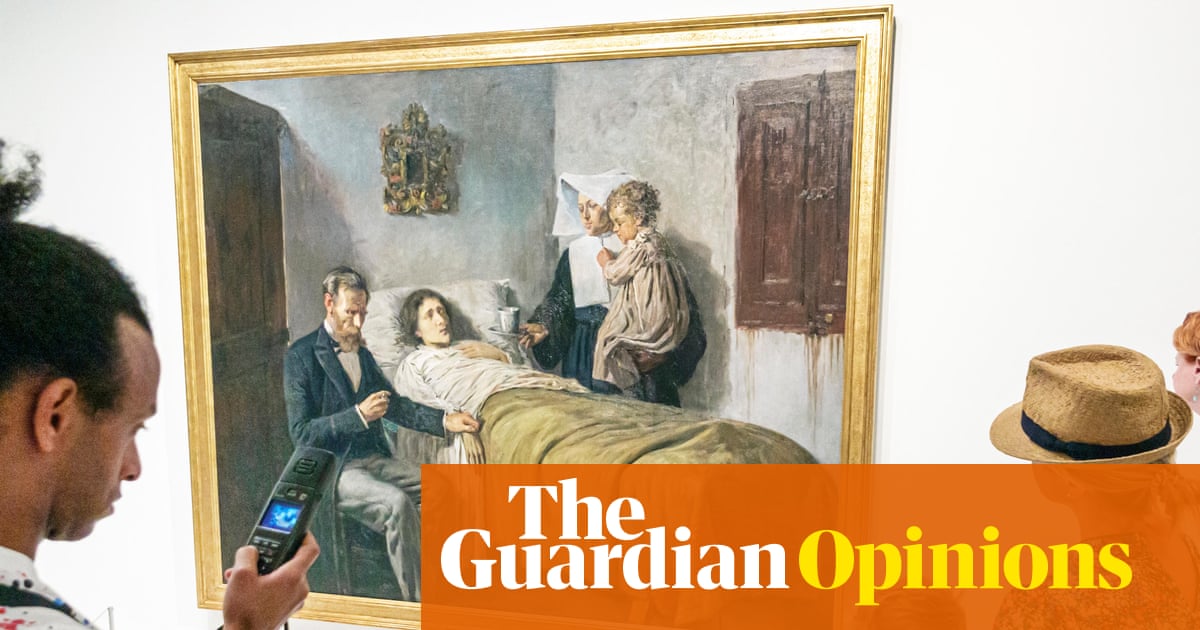
There are excellent reasons for promoting this theory: the ability of art in any form to take us out of ourselves and put us back in a slightly different place. What is fascinating to me is how Art Fund has found it necessary to sell the idea by appealing to a standard that, if not antithetical to art, exactly, seems at the very least to be highly irrelevant. In other words, the key sell for engaging with art in this case is that there is science – a real expertise! – backing it up, to reassure those on the fence that it’s not all a clanging, nebulous waste of time.
There’s probably a way to blame Malcolm Gladwell for this, or take your pick from any number of other narrow-track, extremely literal thinkers who don’t trust any experience of life that can’t be tabulated. And while Art Fund is just conforming to publishing trends, which require measurable takeaways from every single thing we do, I can’t help finding something dispiriting and babyish about the way they’ve gone about it. Not to get too Walter Pater about it all, but the minute you start trying to measure future benefits in relation to standing in front of a painting or reading a book, not only do you wander into upsetting territory where phrases such as “value proposition” and “what’s the unlock on this?” reside, but it risks interfering with the experience itself.
I know, I’m being a snob. The enthusiasm for boiling life down to a series of self-optimising items on an endless, dreary to-do list, however, does get a bit much at times. In this particular case, it is technically true, I suppose, that art belongs in a very broad category with nutrition.
And you can hold two apparently contradictory thoughts in your head at the same time, so that the fleeting experience of being immersed in an artwork can live alongside the understanding that there is some future, unspecified benefit to the exercise. But when so much weight is put on health and welfare as the ultimate goal, it does risk shifting the experience from pleasure to chore. A more accurate presentation of the value of art might be that going to the National Gallery for the afternoon is less like eating a bowl of grains and doing a quick workout than spooning frosting into your mouth, fixing you greedily and indulgently in the thrill of the moment.
Only guess what?! Without the cholesterol! Is the science of art-as-health-benefit a real science?
I’ll never find out because, apparently, I have no desire to improve myself by reading the data – although if curiosity or a whimsical need to do something I’m not interested in ever gets the better of me, I’ll certainly look into it. All of which misses the point, of course, which is about selling a laudable and true idea about how art enriches your life to a possibly sceptical public. I tip my hat to Art Fund for framing this conviction in a publicity-friendly way, which is surely more sensible than wanging on about hard, gemlike flames and watching it dive to the bottom of the news list.
Just allow me a quick eyeroll first. skip past newsletter promotion after newsletter promotion Emma Brockes is a Guardian columnist
Source: The Guardian