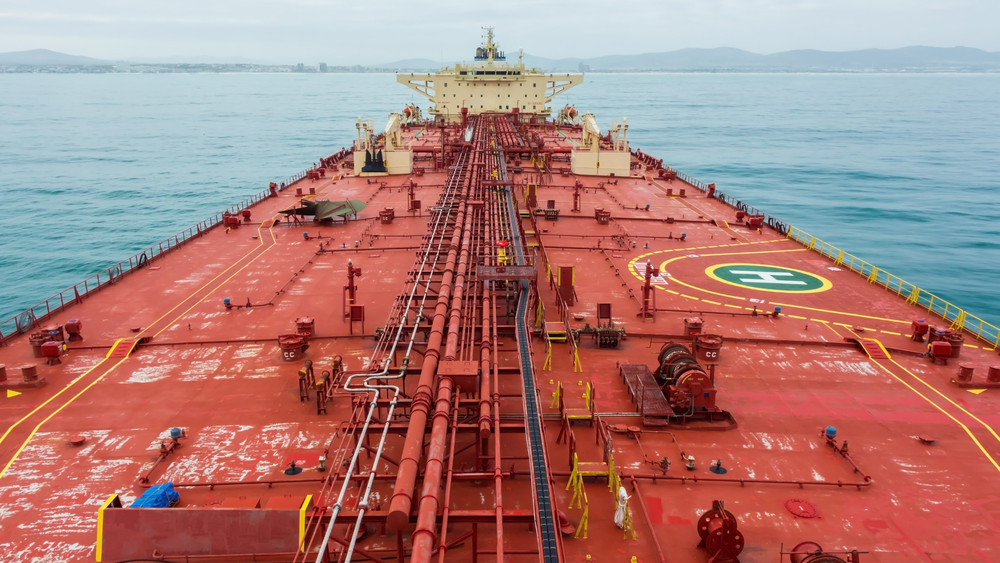
Home Energy Energy-General By RFE/RL staff - Oct 01, 2026, 2:00 PM CDT Middle East crude exports have recovered sharply, with JPMorgan estimating flows at 17.5 million bpd, or 98% of pre-war levels. Producers and shippers are increasingly relying on pipelines, shuttle tankers and ship-to-ship transfers to keep crude moving despite continued security risks around Hormuz. Refined-product supplies have recovered much more slowly, contributing to record diesel prices and persistent pressure on global fuel markets.
Exports of crude oil from the Middle East hit their highest level in September since the war with Iran began, reinforcing a trend of increased supplies despite Iranian attacks on shipping in the Strait of Hormuz, according to analysis of shipping and commodity market data by industry observers. But while crude levels have risen, the refinery bottleneck that has caused a global spike in diesel prices persists. European Union figures published on October 1 showed diesel pump prices at record levels.
Prices have also surged in the United States despite the recovery in oil exports. "More oil is coming out of the Middle East Gulf than many expected that would be possible even just a few months ago," Richard Meade, chief editor of Lloyds List, told an online briefing on October 1. Roll Out The Barrel Lloyds List data shows a steady upward curve of crude tanker transits through the Strait of Hormuz since mid-July, following a sharp fall that coincided with the collapse of the US-Iran memorandum of understanding aimed at ending the conflict, now in its eighth month.
Investment bank JP Morgan said Middle East crude exports in September were at 98 percent of pre-war levels, describing it as "a remarkable recovery for a region still at war." Commodities analytics firm Kpler reported Saudi oil exports were at average levels for 2025, while maritime intelligence company Windward said Saudi terminals loaded four times more oil than in August -- a big increase but still nearly 40 percent lower than in January. There appear to be a number of factors behind the revival, including the Saudi East-West oil pipeline, the use of oil shuttles and ship-to-ship oil transfers, and a willingness by some in the industry to accept higher risk. The Saudi pipeline, which pumps its crude to the Yanbu port on the Red Sea to bypass the Strait of Hormuz, was damaged in an attack by Iran-aligned Houthi militants on September 10.
An uptick in shipments from Yanbu later in the month, however, suggested the pipeline had regained at least some of its lost operational capacity. The United Arab Emirates has found a similar solution, using its pipeline to the port of Fujairah on the Gulf of Oman. It has been targeted in Iranian attacks but is far less vulnerable than Hormuz.
Another route to market has been to use smaller shuttle vessels to transport crude through the Strait of Hormuz, using a route hugging the Omani coastline patrolled by the US Navy. These ships, often traveling in a convoy, pump their cargoes onto tankers in the safety of the Gulf of Oman. Meanwhile, refineries in India have reportedly begun commissioning tankers to use the route directly.
Attacks Continue The risks to shipping have not disappeared. In the latest incident, three Liberian-flagged tankers were struck by unknown projectiles when transiting the Strait of Hormuz on September 30. Industry analysts suggest the dangers have simply been priced in.
"Higher exports do not necessarily mean that the Strait of Hormuz has become safe. They simply show that the oil industry has become accustomed to working around that danger," Meade said. Crude prices have retreated from recent highs, but refinery bottlenecks remain a global issue.
According to the International Energy Agency (IEA), much of this is in the Persian Gulf. Iranian attacks on refineries combined with Hormuz shipping disruption have led to a collapse in output, the IEA said. "In 2025, Middle East producers exported 3.3 million barrels per day of refined oil products.
But since the conflict began, as much as 3 million barrels per day of refining capacity has been unavailable," the IEA wrote in a note on September 21. This global diesel shortage has been compounded by Ukrainian attacks on Russian oil refineries, leading the Kremlin to impose a diesel export ban. "Refineries around the world are already stretched to capacity," the IEA said.
"This leaves few available options to prevent a further tightening of supplies and higher prices in the coming months." By RFE/RL More Top Reads From Oilprice.com India Emphasizes That Shipping Chaos, Not Supply, Is Driving High Oil Prices Indian Refiners Seek Tankers for Hormuz Oil Trump Admits Diesel U.S. Export Ban Could Raise Gasoline Prices Download The Free Oilprice App Today Back to homepage RFE/RL staff RFE/RL journalists report the news in 21 countries where a free press is banned by the government or not fully established. We provide what many...
More Info Leave a comment EXXON Mobil -0.35 Open 57.81 Trading Vol. 6.96M Previous Vol. 241.7B BUY 57.15 Sell 57.00